Panda Corydoras
The Panda Corydoras, currently classified under the scientific name Hoplisoma panda and historically known as Corydoras panda, is a small bottom-dwelling fish native to South America, more specifically Peru.
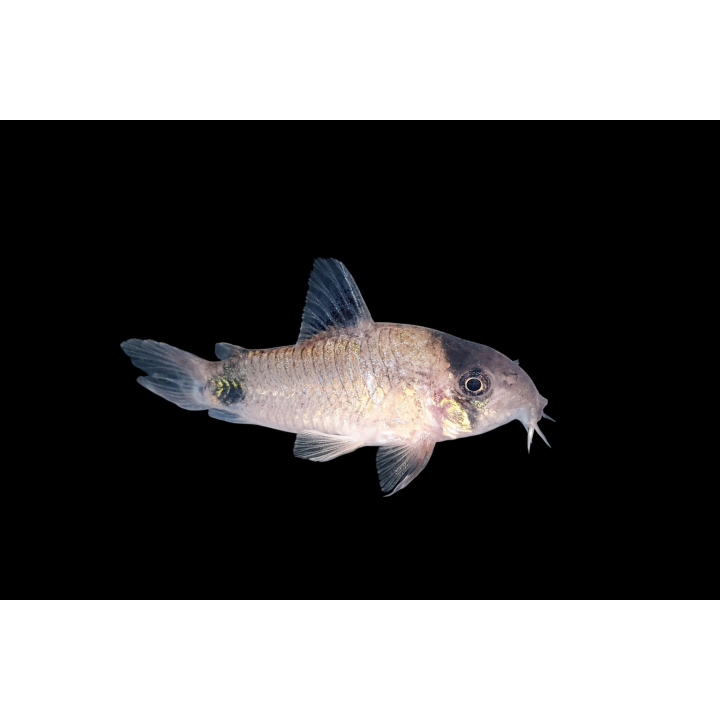
It takes its name from its distinctive colouration: its pale body contrasts with several black markings, particularly around the eyes, on the dorsal fin and at the base of the caudal fin, reminiscent of the markings of a panda.
The specimens offered here are approximately 2.5 to 3 cm.
Adult Size of the Panda Corydoras
The Panda Corydoras remains relatively small, generally reaching around 4 to 5 cm as an adult.
Adult females are usually larger and have a more robust, rounded body than males.
A Sociable Fish to Keep in a Group
The Panda Corydoras is a sociable, shoaling fish and should not be kept alone.
A group of at least 6 individuals is recommended. When aquarium size allows, a larger group encourages the expression of natural social behaviour.
The fish regularly move together and spend much of their time exploring the bottom of the aquarium.
What Size Aquarium Does a Panda Corydoras Need?
The amount of available floor space is particularly important for this species. An aquarium with a footprint of approximately 45 × 30 cm minimum can accommodate a small group, although a larger aquarium provides more space for keeping a larger group.
The substrate should be fine and non-abrasive. Fine sand is particularly suitable for the natural behaviour of Panda Corydoras, which use their barbels when searching for food in the substrate.
Plants, roots and shaded areas can be included while maintaining sufficient open areas along the bottom.
Water Parameters
Temperature: 22 to 25 °C
pH: 6 to 7.5
Water: soft to moderately hard
Nitrite: 0 mg/L
The Panda Corydoras prefers a relatively moderate water temperature. Keeping this species permanently at high temperatures, particularly around 28 °C, is not recommended.
Nitrite should remain undetectable. Clean, stable, properly filtered water and regular aquarium maintenance are important for this species.
Feeding the Panda Corydoras
The Panda Corydoras has an omnivorous diet.
In the aquarium, it readily accepts sinking pellets and tablets suitable for bottom-dwelling fish. Its diet can be supplemented with Artemia, Daphnia, bloodworms and other suitably sized live or frozen foods.
A varied diet helps maintain the fish in good condition.
The Panda Corydoras should not be regarded as a “cleaner fish” expected to survive on leftovers from other fish. It requires a complete diet specifically provided for it.
Behaviour and Compatibility
The Panda Corydoras is a very peaceful and sociable fish. It is particularly suitable for community aquariums with other peaceful species that have compatible temperature and water requirements.
Although it spends most of its time near the bottom, it may regularly swim rapidly to the surface to take in a small amount of air. This is normal behaviour for Corydoras.
Breeding the Panda Corydoras
The Panda Corydoras is an egg-laying fish.
As with many Corydoras, the male and female may adopt the characteristic “T-position” during breeding.
The female then gradually attaches the eggs to various surfaces within the aquarium, including the glass, plants or other suitable surfaces.
The parents provide no parental care and may eat the eggs. For controlled breeding, the eggs or breeding adults can therefore be separated.
Origin of the Panda Corydoras
The Panda Corydoras is native to South America. It naturally occurs in the upper Amazon basin in Peru.
It inhabits streams and tributaries, including areas with sandy substrates. Some parts of its natural habitat receive relatively cool water originating from Andean regions.
Lifespan
Under suitable aquarium conditions, the Panda Corydoras can live for approximately 5 to 8 years, with some individuals potentially living longer.
Conservation Status
The Panda Corydoras, currently classified as Hoplisoma panda, is listed as NT – Near Threatened on the IUCN Red List.
Never Release Aquarium Fish into the Wild
Aquarium fish must never be released into a river, pond, lake or any other natural environment, in order to protect natural ecosystems and wildlife.
Key Facts About the Panda Corydoras
- common name: Panda Corydoras;
- current scientific name: Hoplisoma panda;
- historical scientific name: Corydoras panda;
- size offered: 2.5 to 3 cm;
- adult size: approximately 4 to 5 cm;
- origin: upper Amazon basin in Peru;
- very peaceful, sociable bottom-dwelling fish;
- group of at least 6 individuals recommended;
- fine, non-abrasive substrate recommended;
- temperature: 22 to 25 °C;
- pH: 6 to 7.5;
- omnivorous diet;
- egg-laying reproduction;
- lifespan: approximately 5 to 8 years;
- IUCN status: NT – Near Threatened.


Comments (0)
Your review appreciation cannot be sent
Report comment
Report sent
Your report cannot be sent