Cherry Barb – Puntius titteya
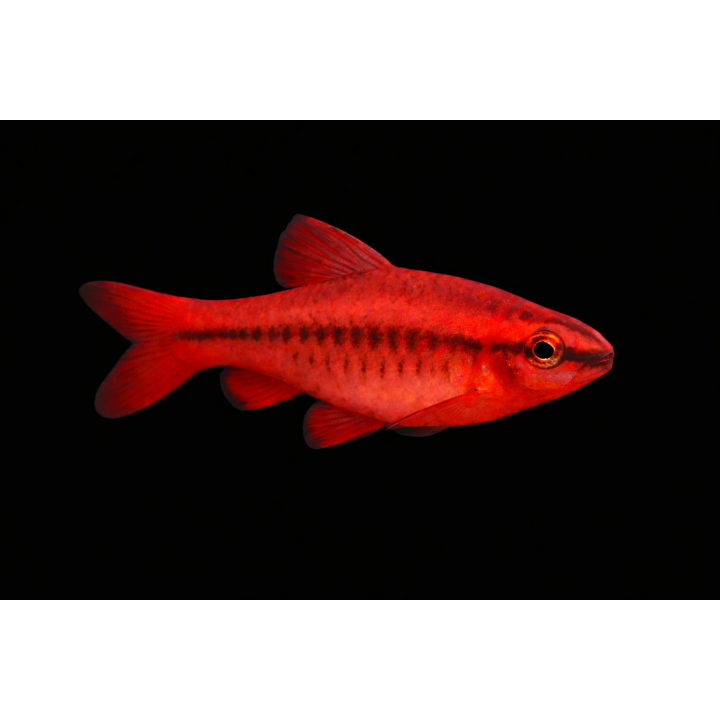
The Cherry Barb (Puntius titteya) is a small cyprinid native to Sri Lanka. Popular in the aquarium hobby, it is particularly well known for the striking red colouration that adult males can develop.
The specimens offered here are approximately 2 cm.
Colouration of the Cherry Barb
Juvenile Cherry Barbs have relatively subtle, predominantly silver colouration. Their colours become progressively more pronounced as they grow.
In adults, sexual dimorphism is clearly visible. Males generally develop a much more intense red colouration, which can become particularly striking when they are in breeding condition.
Females display more subtle colouration, generally orange to brownish, and often develop a fuller body shape when mature.
Adult Size of the Cherry Barb
The Cherry Barb is a relatively small species and can reach approximately 5 cm as an adult.
Its modest size makes it suitable for reasonably sized aquariums, provided its social behaviour and need for group maintenance are taken into account.
A Shoaling Fish to Keep in a Group
The Cherry Barb is a sociable, shoaling fish that should be kept with several members of its own species.
A group of at least 5 to 6 individuals provides a good starting point. Larger groups can be kept when aquarium size allows.
Keeping Cherry Barbs in a group allows them to display their natural social interactions and also highlights the attractive colouration of adult males.
What Size Aquarium Does a Cherry Barb Need?
An aquarium measuring at least 60 cm in length provides a good basis for keeping a small group.
The Cherry Barb is particularly well suited to planted aquariums with a combination of vegetation, sheltered areas and sufficient open swimming space.
In its natural habitat, the species is found in relatively calm, shallow and shaded streams with abundant vegetation and plant debris.
Water Parameters
Temperature: 23 to 27 °C
pH: 6 to 8
Hardness: approximately 5 to 19 °dGH
Nitrite: 0 mg/L
Nitrite should remain undetectable. Stable, properly filtered water and regular aquarium maintenance are essential.
Feeding the Cherry Barb
Puntius titteya is omnivorous.
In its natural habitat, its diet includes small invertebrates and insect larvae as well as algae, diatoms, detritus and plant material.
In the aquarium, it readily accepts appropriately sized pellets and flakes.
Its diet can be supplemented with Artemia, Daphnia, insect larvae and other suitable frozen or live foods.
A varied diet contributes to healthy development and helps the fish display their natural colouration.
Behaviour and Compatibility
The Cherry Barb is an active but generally relatively peaceful fish when kept under suitable conditions and with enough members of its own species.
It can be kept in a community aquarium with species of compatible size, behaviour and water requirements.
Breeding the Cherry Barb
The Cherry Barb is an egg-laying, egg-scattering fish.
Spawning takes place among plants and fine vegetation, where the eggs are scattered.
The parents provide no parental care and may eat the eggs. For controlled breeding, the adults can therefore be separated from the eggs after spawning.
Origin of the Cherry Barb
Puntius titteya is native to Sri Lanka, where the species occurs in river basins including those between the Kelani and Nilwala rivers.
It primarily inhabits small, shaded and shallow streams with relatively slow-moving water.
Lifespan
Under suitable aquarium conditions, the Cherry Barb can live for approximately 5 to 6 years.
Conservation Status
Puntius titteya is currently classified as VU – Vulnerable on the IUCN Red List.
Wild populations are notably affected by habitat degradation, making the conservation of natural populations particularly important.
Never Release Aquarium Fish into the Wild
Aquarium fish must never be released into a river, pond, lake or any other natural environment, in order to protect natural ecosystems and wildlife.
Key Facts About the Cherry Barb
- scientific name: Puntius titteya;
- common name: Cherry Barb;
- size offered: approximately 2 cm;
- adult size: up to approximately 5 cm;
- origin: Sri Lanka;
- sociable, shoaling fish to be kept in a group;
- adult males develop intense red colouration;
- temperature: 23 to 27 °C;
- pH: 6 to 8;
- omnivorous diet;
- egg-scattering reproduction among vegetation;
- lifespan: approximately 5 to 6 years;
- IUCN status: VU – Vulnerable.


Comments (0)
Your review appreciation cannot be sent
Report comment
Report sent
Your report cannot be sent